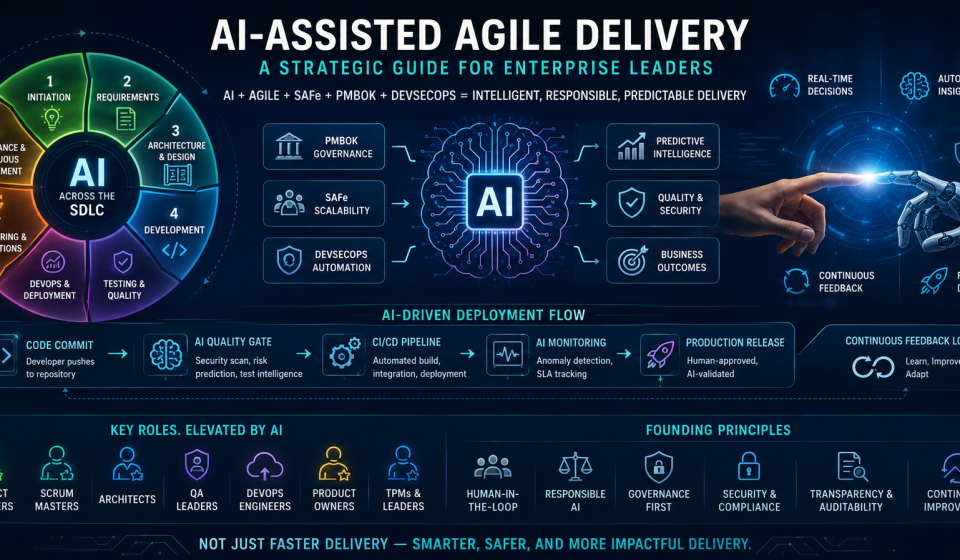
AI-ASSISTED AGILE DELIVERY – Challenges, Governance & Practical Strategies for Modern SAFe Enterprises

Introduction: AI Is No Longer a Experiment
When I started in software delivery back in 2005, we were writing PHP and Drupal code by hand, doing deployments through FTP clients, and managing requirements in Excel sheets. Fast forward to today — and my teams are using AI copilots to generate test cases, AI analytics to predict sprint health, and GenAI to auto-draft release notes.
The pace of this shift is breathtaking. And I say this as someone who has lived through every major evolution in software delivery — from Waterfall to Agile, from Agile to SAFe, and now from SAFe to AI-assisted delivery.
Artificial Intelligence is no longer an experimental capability. It is becoming a delivery accelerator, decision-support engine, quality enhancer, governance assistant, and productivity multiplier across the entire Software Development Lifecycle (SDLC). At CGI Inc. where I led delivery for 11+ years, I witnessed firsthand how Agile adoption improved project performance by 60% and reduced operational costs by 15%. Now I’m convinced that AI-assisted delivery has the potential to multiply those gains — but only if governed correctly.
AI does not eliminate Agile. AI amplifies Agile. But amplified speed without amplified governance is a recipe for technical debt at scale.
This is what every Agile leader, SAFe practitioner, and Technical PM needs to understand right now. Organizations adopting Agile, DevOps, and SAFe are integrating Generative AI, predictive analytics, AI copilots, intelligent automation, and AI agents into delivery pipelines. The modern delivery leader must move beyond isolated experimentation toward enterprise-scale AI-assisted delivery models — with governance built in from day one.
What AI Is Doing Across Today’s Delivery Teams
| Role | AI Capability in Use |
|---|---|
| Product Owner | Backlog refinement, story generation, acceptance criteria |
| Architect | Solution modeling, threat detection, diagram generation |
| Developer | AI copilots for code, refactoring, documentation |
| QA Engineer | Test case generation, defect prediction, automation |
| DevOps Engineer | Intelligent CI/CD, deployment anomaly detection |
| Scrum Master | Sprint analytics, retrospective insights, team health |
| RTE / PM | Dependency forecasting, risk prediction, portfolio dashboards |
| Executive | AI-powered portfolio governance and delivery analytics |
| ⚠️ The Other Side of the Story
Despite massive acceleration, organizations are grappling with AI hallucinations, security vulnerabilities, technical debt explosion, governance gaps, compliance concerns, skill degradation, and ethical risks. Speed without structure is a ticking time bomb. |
The Evolution of Software Delivery
I’ve personally lived through most of these eras. I joined the industry when Waterfall was gospel. I became a Scrum Master when Agile was still seen as ‘startup methodology.’ I helped drive SAFe adoption across distributed teams spanning three countries. Each shift demanded more from leaders — not just technical knowledge, but the ability to bring people along on the journey.
Now, AI is the next frontier. And the pattern is familiar: rapid adoption, early wins, then the governance challenges catch up.
| Era | Key Characteristics | Primary Limitation |
| Waterfall | Sequential, document-heavy execution | Slow feedback cycles |
| Agile | Iterative delivery, team collaboration | Scaling complexity across enterprises |
| DevOps | Continuous integration and delivery | Operational overhead at scale |
| SAFe | Enterprise agility, ART-based execution | Coordination across value streams |
| AI-Assisted Delivery | AI-augmented SDLC across all phases | Governance and trust gaps |
| AI-Native Delivery (Emerging) | AI-first engineering workflows | Human oversight and ethics |
The key insight from my experience: every era asked teams to give up control in exchange for speed. Waterfall gave way to iterative sprints. Manual deployments gave way to CI/CD. Now, human-written requirements are giving way to AI-generated user stories. The leaders who thrived across these transitions were those who embraced the new capability while protecting the discipline.
PMBOK + SAFe + AI: A Hybrid Delivery Model That Works
In my years at CGI, I worked extensively across PMBOK-governed programs and SAFe-scaled ARTs. I know how both frameworks complement each other — and how AI can enhance both, when applied thoughtfully.
| PMBOK Contributes →• Portfolio Vision and Epics
• Lean business case generation • Stakeholder identification • Risk register and assumptions log • Structured governance gates |
SAFe Contributes →• Agile Release Trains (ARTs)
• PI Planning and iteration cadence • DevOps Continuous Delivery Pipeline • Inspect and Adapt ceremonies • Lean Portfolio Management |
AI enhances both. It accelerates backlog refinement, predicts delivery risks, automates test coverage, and powers governance dashboards. The combination of PMBOK discipline + SAFe agility + AI intelligence is the enterprise delivery model for the next decade.
Mapping PMBOK Process Groups with SAFe and AI
| PMBOK Process Group | SAFe Alignment | Where AI Adds Value |
| Initiating | Portfolio Vision, Epic Definition | Market analysis, business case generation, stakeholder mapping |
| Planning | PI Planning, Backlog Management | Sprint forecasting, dependency identification, story generation |
| Executing | Iteration Execution, ART Delivery | Code generation, test automation, CI/CD optimization |
| Monitoring & Controlling | Inspect & Adapt, ART Sync | Predictive analytics, risk alerts, delivery dashboards |
| Closing | Release, Retrospective, PI Review | AI-generated lessons learned, portfolio insights |
AI Across the SDLC — A Phase-by-Phase Deep Dive
Phase 1: Initiation — Starting Smart with AI
Every significant program I’ve delivered started with ambiguity. Stakeholders have goals but not clarity. AI now gives delivery leaders a powerful tool to convert ambiguity into structure, faster than ever before.
What AI Does in Initiation
- Analyzes customer feedback, competitor products, and market trends at scale
- Drafts executive summaries, ROI projections, and stakeholder summaries
- Maps stakeholder influence and predicts communication risks
- Generates lean business cases aligned with SAFe portfolio vision
| 🏦 Real-World Example I’ve Seen
When a large insurance client needed a new customer claims portal, an AI model analyzed thousands of support tickets to surface the top 15 pain points and propose feature priorities — a process that would have taken a business analyst 3-4 weeks. The AI did it overnight. But the critical step was human validation of every output before it influenced the business case. |
AI Tools for Initiation
| Use Area | Recommended Tools |
| Research & Ideation | ChatGPT, Claude, Gemini |
| Market Analysis | Power BI AI, Tableau AI |
| Documentation | Notion AI, Confluence AI |
| Strategic Planning | Jira AI, Aha! AI |
| ⚡ Governance Guardrails — Initiation Phase• Never upload enterprise strategy documents to public AI systems
• Human validation mandatory for all AI-generated business cases • Use only enterprise-approved AI platforms • Establish prompt engineering standards for your organization • Flag AI-generated content separately in project charters |
Phase 2: Requirements & Backlog — Where AI Delivers the Biggest ROI
I have seen backlog grooming sessions that lasted 4+ hours across distributed teams with 40 members, arguing over story wording and acceptance criteria. AI doesn’t eliminate those conversations — but it gives teams a starting point that dramatically accelerates them.
GenAI is significantly impacting planning and requirements activities across the industry. In my experience, AI-assisted backlog grooming can reduce story preparation time by 40-60% when done right.
AI Capabilities in Requirements Engineering
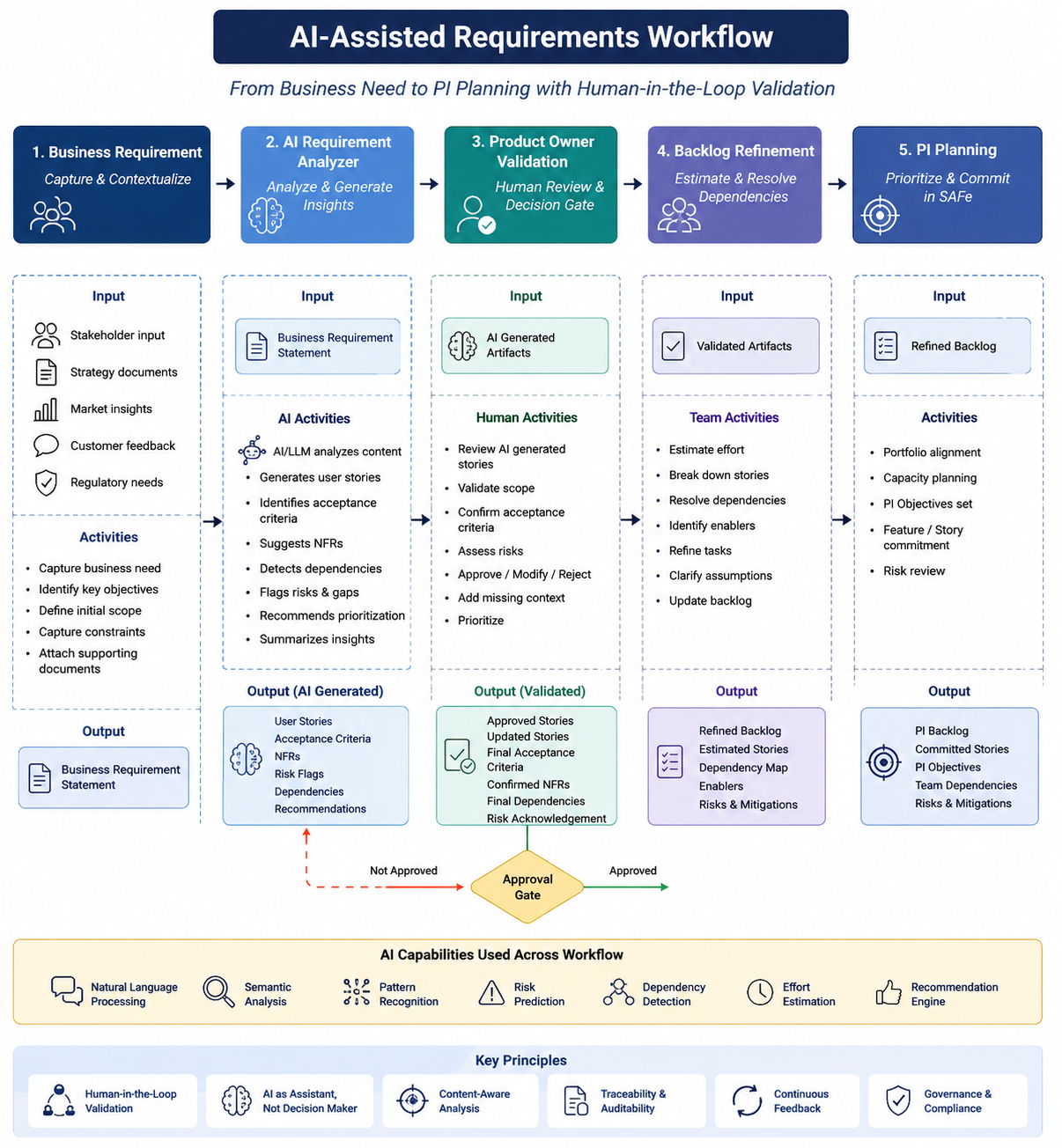
- Generates user stories with acceptance criteria and edge cases from business requirements
- Maps cross-team dependencies and integration risks automatically
- Detects duplicate or conflicting stories in the backlog
- Recommends prioritization based on value, risk, and dependency patterns
- Forecasts sprint capacity based on historical velocity and complexity
AI-Assisted Requirements Workflow
| Benefit | Risk to Manage |
| Faster backlog creation | Poor prompts produce poor requirements |
| Better acceptance criteria | AI ambiguity can produce wrong scope |
| Dependency visibility | Over-automation reduces business collaboration |
| Better sprint estimation | Missing domain context creates incomplete requirements |
Phase 3: Architecture & Design — AI as Your Design Partner (Not Decision-Maker)
Architecture is where I get most cautious about AI. I’ve seen AI suggest microservices patterns that look elegant on paper but ignore real-world operational complexity. I’ve seen it recommend cloud configurations that missed compliance requirements entirely.
AI is becoming a powerful design assistant — but it must never replace the Architecture Review Board. In my programs, architecture was always a governance checkpoint, not an afterthought. That discipline becomes even more critical when AI is generating design options.
What AI Can Do in Architecture
- Suggest microservices patterns, event-driven architectures, and API structures
- Generate UML, sequence diagrams, API flows, and ER diagrams
- Identify OWASP vulnerabilities, IAM gaps, and encryption requirements
- Recommend cloud-native deployment models and infrastructure patterns
⚡ The Architecture Governance Rule I Never Break• AI-generated architecture must pass Architecture Review Board validation • Treat AI as a design assistant, never as the decision-maker • Maintain reusable enterprise architecture patterns as guardrails • Enforce security-by-design — AI commonly misses observability and resiliency • Document all AI-generated architectural decisions with human rationale added |
Phase 4: Development — The Most Transformed SDLC Phase
This is where AI has made the most dramatic impact in the shortest time. When I was a technical lead and later a project manager at CGI, developers would spend hours on boilerplate code, API scaffolding, and writing unit tests. Today, AI copilots handle much of that in minutes.
I’ve personally used GitHub Copilot, ChatGPT, and PMI Infinity in my delivery work. The productivity gains are real. But so are the risks — especially when junior developers stop questioning what the AI generates.
AI Development Capabilities
- Generates APIs, CRUD operations, UI components, and database queries
- Identifies code complexity hotspots and recommends refactoring
- Auto-generates README files, API docs, and technical specifications
- Suggests unit test coverage based on code analysis
- Accelerates developer onboarding with context-aware code explanations
| Benefit | Reported Industry Impact |
| Development acceleration | 20-50% faster delivery cycles |
| Reduced boilerplate coding | Higher productivity on complex logic |
| Automated documentation | Improved maintainability and knowledge transfer |
| Faster onboarding | Reduced ramp-up time for new team members |
The Risks I’ve Witnessed Firsthand
| Security Risks →• Hardcoded credentials in AI-generated code
• SQL injection and validation gaps • Copyright and licensing violations • Developers losing foundational coding depth |
Delivery Risks →• AI acceleration outpacing governance maturity
• Technical debt accumulates invisibly • Teams over-rely on AI for architectural decisions • Code reviews become superficial |
Phase 5: Testing & Quality — AI Is Reshaping QA Faster Than You Think
AI is genuinely transforming how we think about quality engineering. But here’s what I tell my team: AI can generate test cases, but it cannot replace human judgment about what actually matters to the business. The domain expert who knows that edge case in the insurance claims workflow — that’s irreplaceable.
AI QA Capabilities
- Generates functional, API, UI automation, and regression test cases from requirements
- Predicts high-risk modules and regression hotspots before testing begins
- Auto-heals test locators to stabilize automation frameworks
- Analyzes defect patterns to identify root causes across releases
- Provides intelligent test coverage recommendations
| AI QA Tool Area | Recommended Tools |
| Test Case Generation | Testim, Mabl, GitHub Copilot |
| Test Automation | Copado AI, Watermelon, RestAsured |
| Defect Prediction | Jira AI, Azure DevOps AI Analytics |
| Performance Testing | Dynatrace AI, New Relic AI |
Phase 6: DevOps, CI/CD & Deployment — The AI-Powered Delivery Pipeline
The continuous delivery pipeline is where many of my programs achieved their biggest efficiency gains. Reducing deployment cycles, automating regression gates, and improving release predictability were core to the 60% performance improvement I delivered at CGI.
AI is now taking CI/CD to the next level — predicting deployment failures before they happen, optimizing build pipelines, and generating infrastructure-as-code. AWS and industry leaders describe AI-driven delivery pipelines as the next evolution of software engineering.
AI-Driven Deployment Flow:
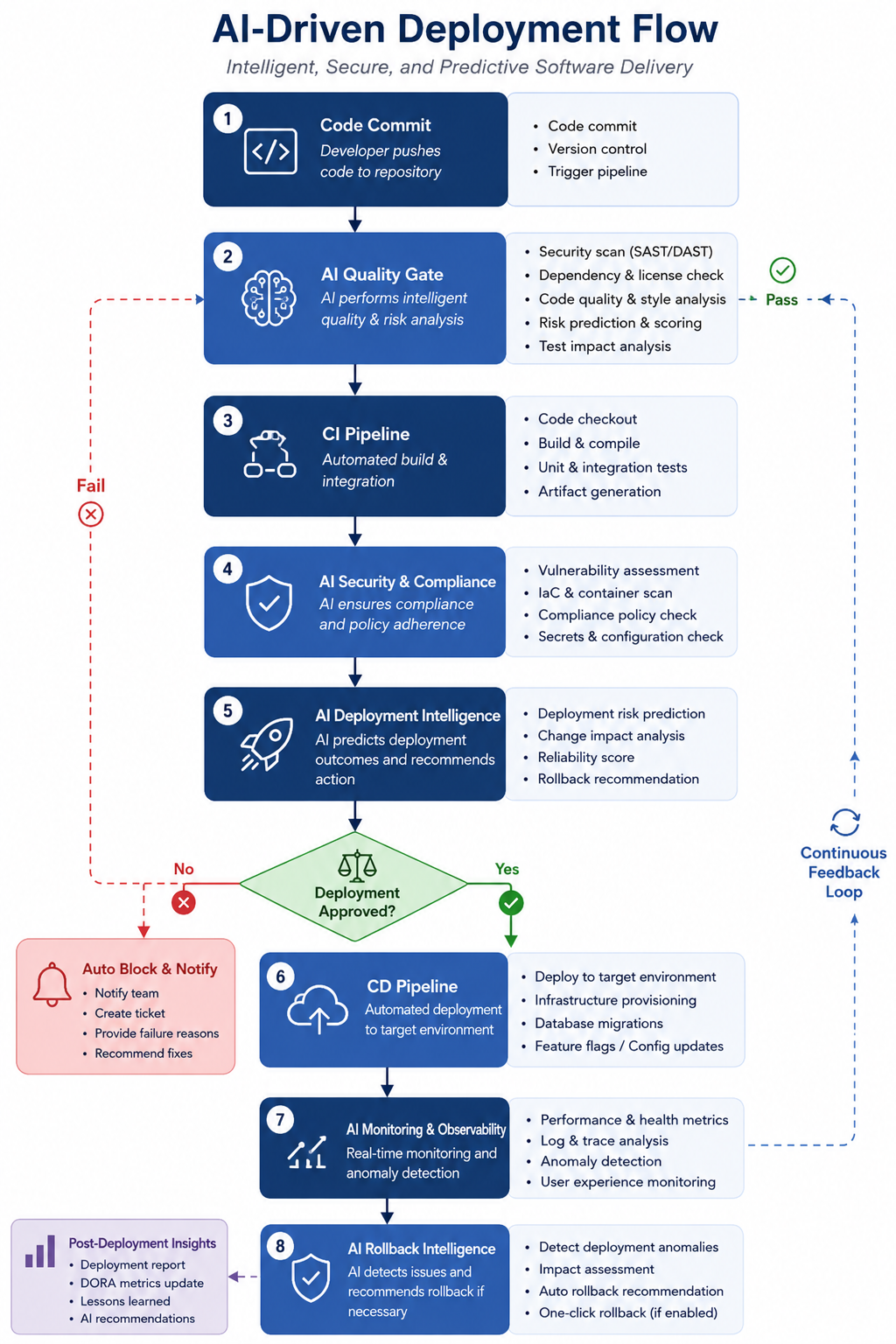
⚡ DevSecOps Non-Negotiables• Human approval required for every production deployment — no exceptions • Zero-trust AI pipeline design: AI recommends, humans decide • AI governance audits built into release cadence • DevSecOps enforcement: security scanning at every pipeline stage • AI audit logging for compliance and traceability |
Phase 7: Operations & Monitoring — AI That Never Sleeps
Operational stability was always a core KPI for my programs. At CGI, I improved incident resolution by 30% through ITIL-aligned processes. AI now allows teams to move from reactive incident management to predictive operations — catching issues before they become outages.
AI Operational Capabilities
- Detects infrastructure anomalies and user experience degradation in real-time
- Assists with root cause analysis and ticket classification
- Enables intelligent automated remediation for known failure patterns
- Powers L1 support automation through AI chatbots
- Provides predictive SLA risk alerts before breaches occur
Phase 8: Retrospectives & Governance — AI as the Team’s Memory
Retrospectives are one of my favorite Agile ceremonies — because that’s where teams learn. I’ve facilitated hundreds of retros across CGI programs. The challenge is always the same: people remember the last sprint, not the patterns across the quarter.
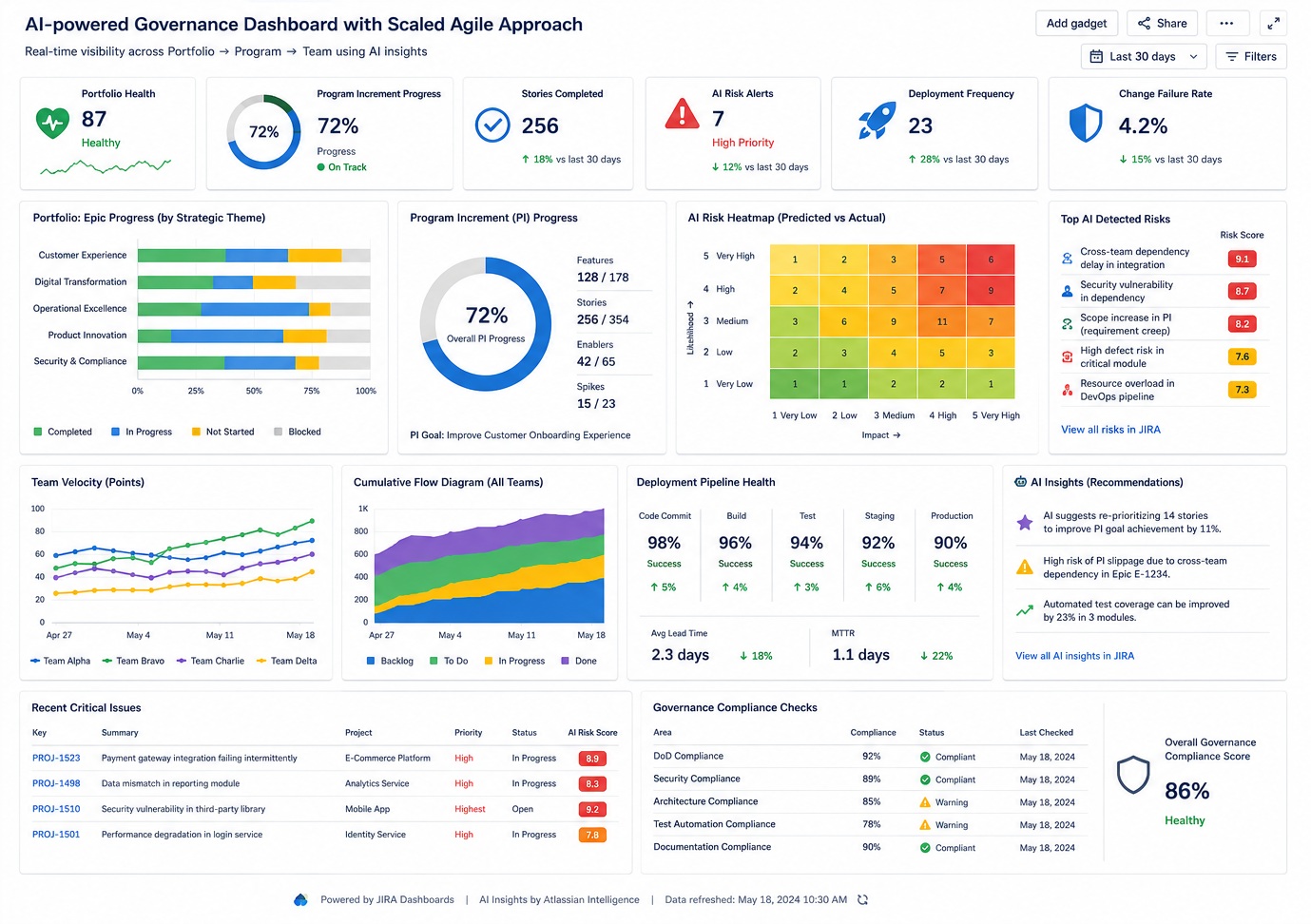
AI changes this. It can analyze sprint metrics, team sentiment, delivery bottlenecks, and defect patterns across entire PI cycles — giving the team insights that no human retrospective facilitator could surface in a 90-minute session.
AI-Powered Governance Dashboard
Enterprise Challenges — The Honest Truth
I want to be direct here, because I’ve seen too many LinkedIn posts that make AI adoption sound effortless. It is not. The challenges are real, significant, and require deliberate leadership to navigate.
| Challenge | What I’ve Observed | Risk Level |
| Governance Chaos | AI adoption outruns governance maturity — teams use AI tools without policies | HIGH |
| AI Hallucinations | AI confidently generates incorrect outputs — especially dangerous in requirements | HIGH |
| Security & Compliance | Source code, customer data, and IP exposed through public AI prompts | CRITICAL |
| Technical Debt Explosion | Fast AI-generated code without quality gates creates unmaintainable systems | HIGH |
| Skill Erosion | Junior engineers lose foundational depth by over-relying on AI | MEDIUM |
| Role Anxiety | Teams fear AI is replacing them — causing resistance to adoption | MEDIUM |
| Ethical & Legal Risk | Copyright, bias, and AI explainability gaps create liability | HIGH |
The Evolving Role of the Agile Leader
AI will not eliminate Agile PMs, SAFe RTEs, or Scrum Masters. I am absolutely certain of this — not out of wishful thinking, but because I understand what we actually do. What will change is where we spend our energy.
| Traditional Responsibility | AI-Augmented Future Responsibility |
| Manual sprint reporting | AI governance and decision oversight |
| Status update facilitation | Delivery intelligence interpretation |
| Dependency tracking in spreadsheets | AI-powered dependency orchestration |
| Writing retrospective summaries | Coaching teams on AI-generated insights |
| Risk log maintenance | Risk orchestration with predictive AI |
| Stakeholder communication | Human-AI collaboration management |
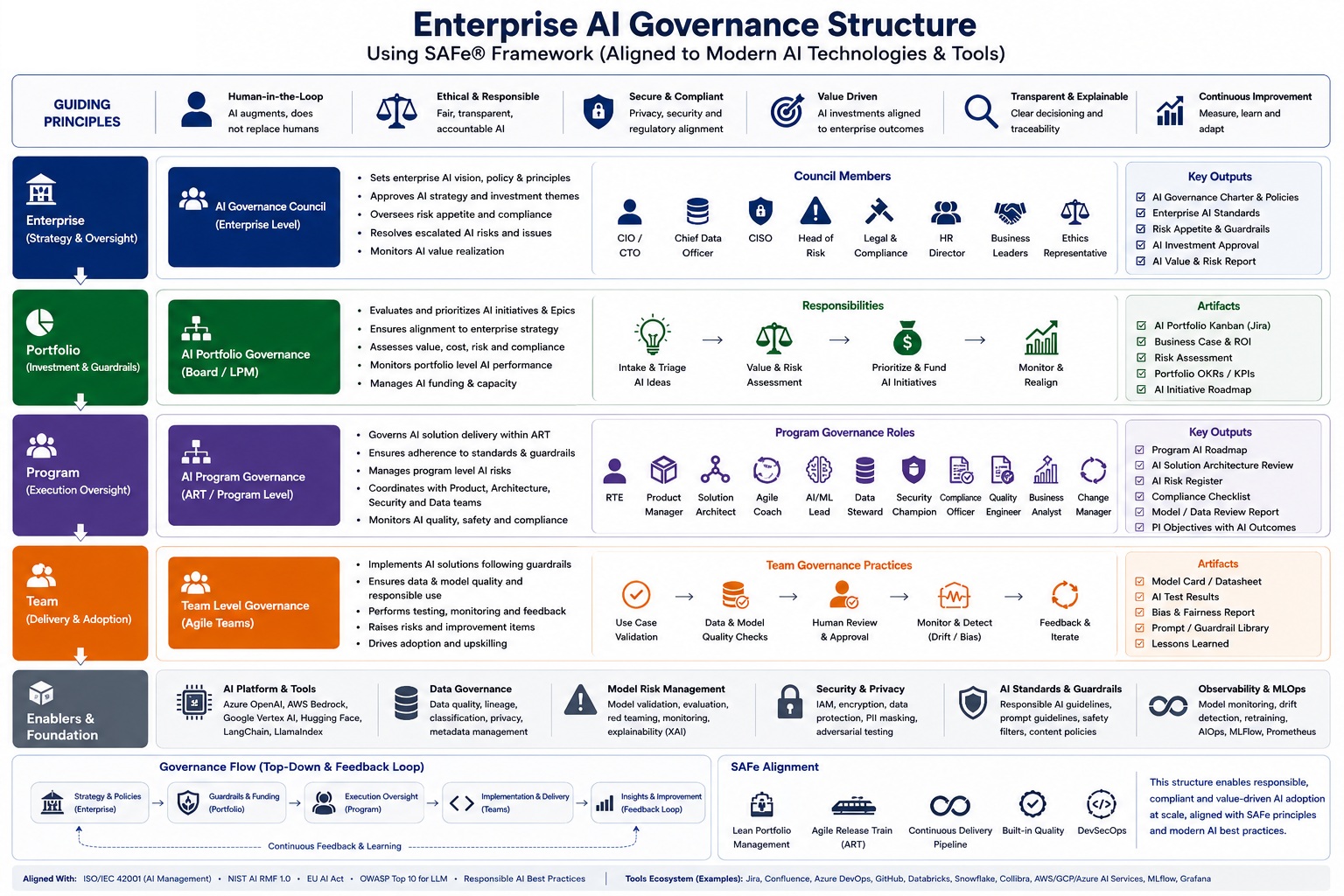
AI Governance Framework for SAFe Enterprises
After years of running ITIL-aligned governance and SAFe delivery governance, I believe the governance model for AI-assisted delivery must be built on six non-negotiable pillars.
| Governance Pillar | Focus Area | Key Controls |
| Security | Data protection and access control | Enterprise-only AI platforms, no public uploads |
| Compliance | Regulatory and policy adherence | AI audit trails, output tagging, review gates |
| Quality | Validation and verification | Human review mandatory, architecture guardrails |
| Ethics | Bias prevention and fairness | Ethics board review, explainability requirements |
| Observability | Auditability of AI decisions | Logging, version control, decision documentation |
| Human Oversight | Final accountability always with humans | Approval gates at every critical delivery point |
Enterprise AI Governance Structure
Recommended AI Toolchain Across the SDLC
| SDLC Phase | Recommended AI Tools | My Experience |
| Initiation & Strategy | ChatGPT, Claude, Gemini, PMI Infinity | Used for business case drafting and research |
| Requirements | Jira AI, Azure DevOps AI, Notion AI | Backlog generation and story refinement |
| Architecture & Design | Lucidchart AI, Draw.io AI, GitHub Copilot | Architecture diagram generation and review |
| Development | GitHub Copilot, Cursor, Claude Code, Windsurf, Amazon Q Developer, Tabnine, JetBrains AI Assistant, Sourcegraph Cody, Replit Ghostwriter, Codeium | code generation, refactoring assistance, unit test creation, API scaffolding, debugging support, documentation automation, secure coding recommendations, and productivity optimization |
| Testing & QA | Testim, Mabl, Copado AI, Watermelon, RestAssured |
|
| DevOps & CI/CD | Harness AI, Dynatrace AI, Jenkins AI | Pipeline optimization and monitoring |
| Operations | Datadog AI, New Relic AI, PagerDuty AI | Incident prediction and SLA management |
| Governance & Analytics | Power BI AI, Tableau AI, Jira AI | Portfolio dashboards and sprint analytics |
Enterprise Adoption Strategy — A Practical Roadmap
Based on my experience driving Agile transformations at enterprise scale, I recommend a four-phase approach to AI adoption. This mirrors how I’ve led previous major transformations — start small, prove value, govern carefully, then scale.
| Phase | Focus | Key Activities | Timeline |
| Phase 1: Pilot | AI Experimentation | Select 2-3 AI tools, define governance, create usage policies, run controlled pilots | Months 1-3 |
| Phase 2: Integration | Controlled Adoption | Integrate into SDLC workflows, add DevSecOps controls, train all teams | Months 4-6 |
| Phase 3: Scaling | Enterprise Expansion | AI-assisted PI Planning, predictive portfolio management, AI observability | Months 7-12 |
| Phase 4: AI-Native | Continuous Innovation | Agentic pipelines, autonomous testing, intelligent release orchestration | 12+ months |
What Agile Leaders Must Do Immediately
I’ll end with practical, actionable guidance. Not abstract principles — concrete next steps, based on what I’m doing myself and recommending to the teams I coach and mentor. Practical, governance-focused actions for CTOs, CDIOs, TPMs, Agile Leaders, Architects, and Engineering Executives adopting AI-assisted delivery at enterprise scale:
For CTOs & CDIOs →
- Define enterprise AI governance before scaling AI adoption
- Establish approved AI platforms, policies, and operating boundaries
- Align AI transformation initiatives with business value streams
- Modernize DevSecOps, observability, and delivery platforms for AI-native operations
- Create executive-level AI risk, compliance, and audit frameworks
- Invest in AI literacy programs across leadership and engineering organizations
- Build enterprise AI architecture standards and reusable delivery patterns
- Track AI adoption through measurable business and engineering KPIs
For Technical Program Managers & PMO Leaders →
- Learn AI governance fundamentals — not just AI tools
- Integrate AI delivery analytics into portfolio governance dashboards
- Build AI risk management frameworks for enterprise programs
- Govern AI-generated artifacts, decisions, and traceability workflows
- Use predictive AI for dependency forecasting and delivery planning
- Standardize AI operating practices across Agile Release Trains (ARTs)
- Establish AI auditability and compliance reporting mechanisms
- Shift focus from coordination toward strategic oversight and decision intelligence
For Scrum Masters & Agile Coaches →
- Use AI for sprint analytics and delivery pattern recognition
- Enable responsible AI adoption through structured Agile coaching
- Facilitate human-AI collaboration ceremonies and retrospectives
- Protect psychological safety during AI-driven organizational changes
- Detect AI-induced Agile anti-patterns and estimation bias early
- Use AI insights to identify recurring impediments and delivery bottlenecks
- Promote ethical and transparent AI usage across delivery teams
- Build continuous learning cultures around AI-assisted delivery practices
For Enterprise & Solution Architects →
- Create AI-safe architecture patterns, standards, and governance guardrails
- Govern AI-generated designs through architecture review boards (ARBs)
- Document AI architectural decisions with clear human rationale and accountability
- Champion resiliency, observability, and scalability in AI-generated systems
- Standardize reusable AI-enabled enterprise integration patterns
- Validate security, compliance, and operational readiness of AI-assisted architectures
- Prevent AI-induced technical debt and architectural fragmentation
- Enable AI-ready cloud-native and event-driven ecosystem strategies
For Engineering Managers & Development Leaders →
- Govern AI-assisted engineering productivity without compromising quality
- Establish coding standards for AI-generated software components
- Prevent uncontrolled technical debt caused by rapid AI-assisted development
- Ensure mandatory human review of AI-generated code and recommendations
- Use AI copilots for acceleration — not replacement of engineering judgment
- Build AI-aware onboarding and developer enablement frameworks
- Track engineering quality metrics separately for AI-generated contributions
- Promote deep engineering expertise alongside AI-assisted productivity
For QA Leaders & Quality Engineering Teams →
- Build AI-assisted quality engineering operating models
- Maintain human exploratory testing — never eliminate it
- Involve domain SMEs in all AI-generated QA reviews and validations
- Track AI-generated test coverage separately for governance and auditability
- Use predictive AI for defect intelligence and regression optimization
- Govern AI-generated automation reliability and validation quality
- Enable intelligent test prioritization and risk-based testing strategies
- Integrate AI insights into enterprise quality dashboards and release governance
For DevSecOps, Security & Platform Leaders →
- Integrate AI security validation into CI/CD pipelines
- Prevent enterprise IP and source-code leakage into public AI systems
- Build zero-trust AI operational and infrastructure models
- Govern AI-generated infrastructure and deployment configurations
- Use AI for predictive deployment risk analysis and anomaly detection
- Establish AI compliance scanning and policy enforcement pipelines
- Monitor AI-driven operational risks and emerging attack surfaces
- Implement enterprise-grade AI observability and audit logging frameworks
For Product Owners & Business Leaders →
- Use AI for intelligent backlog refinement and prioritization
- Validate AI-generated stories and requirements with business stakeholders
- Align AI recommendations with measurable business outcomes and OKRs
- Use AI-driven market intelligence for product strategy decisions
- Ensure customer empathy remains central in AI-assisted product design
- Govern AI-assisted prioritization with human business accountability
- Track value realization from AI-enabled delivery initiatives
- Balance speed, innovation, governance, and customer trust simultaneously
For Enterprise Leadership Teams →
- Treat AI as a strategic operating capability — not merely a productivity tool
- Build governance-first AI adoption models across the enterprise
- Establish AI Centers of Excellence (CoEs) for standardization and enablement
- Align AI transformation with cybersecurity, compliance, and risk strategies
- Redesign organizational KPIs for AI-native delivery ecosystems
- Create transparent AI accountability and escalation structures
- Invest equally in people transformation and technology modernization
- Build resilient, human-governed, AI-augmented enterprise delivery organizations
Final Thoughts — The Future Belongs to Human-Governed AI
After 20 years in this industry, I’ve learned that technology revolutions always arrive faster than organizational readiness. The leaders who thrive aren’t the ones who chase every new tool — they’re the ones who thoughtfully integrate new capabilities into proven delivery disciplines.
AI is genuinely transformative. But enterprises that mistake AI acceleration for engineering maturity will accumulate technical debt, governance failures, and operational instability at unprecedented speed.
The future SDLC is not fully autonomous. It is human-governed, AI-augmented delivery. Organizations that master this balance will deliver faster, innovate continuously, and build resilient enterprise ecosystems.
The future belongs not to organizations that use AI recklessly, but to those that combine Agile adaptability, PMBOK governance, SAFe scalability, DevSecOps discipline, and human-centered leadership with responsible AI adoption.
AI is not replacing Agile. AI is becoming Agile’s next great accelerator and the leaders who will harness that acceleration most effectively are the ones reading this right now.
If this article resonated with you — let’s connect, collaborate, and keep the conversation going.
