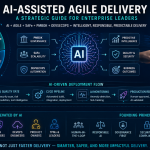
Technical Delivery Management in the Age of AI – Section 5: AI Prompt Library, Ready to use Pocket Reference Micro-eBook

AI Delivery Is Moving Beyond Prompting – From generic AI assistance to role-specific delivery capability
The biggest challenge with AI in IT delivery is no longer access to AI.
It is knowing where AI fits, what context it needs, what output should be produced, how that output should be validated, and where human judgment must remain accountable.
A Technical Delivery Manager assessing a dependency escalation does not need the same AI interaction as a Business Analyst decomposing requirements.
A Cloud Architect evaluating a migration does not need the same approach as a Scrum Master analysing flow.
And an AI Delivery Lead designing an AI-enabled workflow should not approach the problem like someone asking an AI assistant for a summary.
That observation led me to create the AI Delivery Prompt Pocket Library—a practitioner-focused micro-eBook designed to make AI more useful across the IT consulting and technology delivery lifecycle.
What is the AI Delivery Prompt Pocket Library?
This is not another introduction to Generative AI, LLMs, prompting, Agile, or AI agents.
It is designed for practitioners who already understand their profession and need a practical answer to a different question:
“I have this delivery situation right now. How can I use AI effectively to move it forward?”
The library brings together:
206 copy-ready prompts · 19 practitioner roles · 6 delivery functions · 9 Agile methodology adapters
covering delivery leadership, Agile and Product, Business Analysis, Engineering, Architecture, Operations, Quality, Customer Engagement, and AI Delivery & Architecture.
The prompts are designed around the operating sequence:
ROLE → SITUATION → PROMPT → CONTEXT → RUN → VALIDATE → ACT
The objective is not to generate more AI output.
It is to improve the quality and speed of professional thinking, decisions and delivery outcomes.
Why Role-Based AI Matters
One of the recurring problems I see with generic prompting is that the prompt often ignores the professional responsibility of the person using it.
A delivery leader thinks in terms of outcomes, risks, dependencies and governance.
A Product Owner thinks in terms of customer value, prioritization and product decisions.
An Architect thinks in terms of alternatives, constraints, NFRs, integration and trade-offs.
A QA Lead thinks in terms of coverage, defects, risk and release confidence.
An AI Delivery Lead has to think beyond the prompt itself—toward model selection, retrieval, workflows, agents, governance, evaluation, adoption and measurable value.
The library therefore organizes AI around real practitioner roles and situations, rather than treating every professional as simply an AI user.
How I Designed the Library
The prompts are intended to become part of the delivery workflow, not remain isolated chat interactions.
The basic usage is straightforward:
1. Identify your role
Find the practitioner section relevant to your responsibility.
2. Identify the situation
Start with the delivery problem or decision you are actually facing.
3. Select the prompt
Choose the prompt designed for that situation.
4. Add context
Provide the project, systems, evidence, constraints, thresholds, audience and other relevant information.
5. Run and validate
Do not blindly accept the output. Separate:
FACT → INFERENCE → ASSUMPTION → RECOMMENDATION
6. Act
Turn the validated output into a decision, escalation, action plan, requirement, design, governance artifact, communication—or the next AI workflow.
That final step is important.
AI value is realized when output changes what happens next.
A Few Practical Examples
Technical Delivery Manager
Instead of asking:
“Summarize my project status.”
A delivery leader can use AI to identify material exceptions, worsening trends, blocked dependencies and milestone threats, supported by evidence and with explicit handling of missing information.
The result moves from:
Status Summary → Delivery Intelligence → Decision → Action
Business Analyst
Instead of:
“Create user stories from this requirement.”
AI can be used to distinguish confirmed business rules from inferred behaviour, identify ambiguity and contradictions, generate clarification questions, and structure the progression:
Requirement → Business Rules → User Stories → Acceptance Criteria → Test Scenarios
This makes AI a requirements-engineering accelerator, rather than simply a documentation assistant.
Solution Architect
Instead of asking:
“Which architecture is better?”
The practitioner can ask AI to generate viable options and evaluate them against NFRs, cost, scalability, reliability, security, integration, operational complexity and delivery constraints.
The resulting decision structure becomes:
Options → Evidence → Trade-offs → Risks → Recommendation → Decision
That is much closer to the way real architecture decisions are made.
Scrum Master / Agile Practitioner
AI can also move Agile analysis beyond velocity reporting.
For example, sprint data can be examined across commitment, completion, carry-over, blockers, scope change and quality signals, with evidence-backed causes and a specific improvement experiment.
The same underlying thinking can then be adapted across:
Scrum → Sprint
SAFe → PI / ART
XP → TDD / CI / Pairing / Refactoring
Kanban → WIP / Cycle Time / Throughput / Aging
This is why I included Agile methodology adapters rather than duplicating essentially the same prompt for every framework.
From Prompting to AI Workforce Design
For me, this is where the concept becomes more interesting.
The prompt should not necessarily be the final destination.
A useful progression is:
Prompt → Prompt Chain → Workflow → Tool-enabled AI → Agent → Multi-Agent → Human + AI Operating Model
Consider delivery-risk monitoring.
It could evolve from:
Delivery Data
↓
AI Triage
↓
Risk Analysis
↓
Dependency Investigation
↓
Decision Synthesis
↓
Human Approval
↓
Controlled Action
↓
Outcome Measurement
The prompt becomes one component of a larger AI-enabled delivery architecture.
This is also why the library includes an AI-native architecture perspective.
The question should not automatically be:
“Which AI agent should we build?”
It should first be:
“What is the simplest AI capability that can reliably achieve the required outcome?”
Depending on the work, that could mean a fast model, reasoning model, retrieval, deterministic workflow, agent, multi-agent pattern—or human-gated AI.
Context Beats Clever Prompts
One of the strongest principles behind the library is that a sophisticated prompt cannot compensate for poor context.
Instead of giving an AI system everything available and asking it to “find the risks,” provide the relevant evidence:
- Milestone data
- RAID
- Dependencies
- Delivery trends
- Historical risks
- Decision records
- Applicable constraints
Then ask it to reason over that evidence.
The principle is simple:
Retrieve the right context—not all the context.
This improves relevance while also helping manage cost, latency and decision quality.
Prompt Quality Is Only One Part of the Equation
A production-oriented AI interaction should make five things clear:
What outcome are we trying to achieve?
What evidence does AI need?
What rules should it apply?
What exact output should it produce?
Where must a human validate or approve?
That is why the library structures prompts around elements such as:
Context → Objective → Inputs → Constraints → Decision Rules → Sources → Output Contract → Validation → Escalation
This turns prompting from an informal skill into a repeatable delivery practice.
Who Is This For?
I built the library for the broader technology delivery ecosystem:
Delivery & Program Leadership
TDM · PM · Program Manager / TPM · PMO / Transformation Lead
Agile & Product
Scrum Master · Agile Practitioner · Product Manager / Product Owner · Business Analyst
Engineering & Architecture
Technical Lead · Solution Architect · Cloud Architect · Infrastructure Architect · Enterprise Architect · Security Architect · Data Architect
Operations & Quality
DevOps / SRE / Platform Engineer · QA / Test Lead · Service Delivery / IT Operations
Customer & Engagement
Customer / Engagement / Presales
AI Delivery & Architecture
AI Product Manager · AI Architect · AI Delivery Lead
The intent is to establish a common AI-assisted delivery language across roles, while respecting the different decisions, responsibilities and controls associated with each profession.
The Bigger Idea
The real value of this library is not 206 prompts.
The prompts are the practical entry point.
The larger objective is to help professionals learn how to connect:
Role + Situation + Context + AI Capability + Workflow + Human Judgment + Business Outcome
That is the shift I believe organizations need to make.
Not:
“What can AI do?”
But:
“What outcome am I responsible for, what decision drives it, and what part of that work can AI reliably accelerate?”
From there, choose the appropriate:
Prompt → Model → Context → Workflow → Agent → Human Decision
My Pocket Principle
The future of AI-enabled delivery will not belong simply to professionals who know how to use AI.
It will increasingly favor professionals who can design the interaction between AI capability, enterprise context, delivery workflows and human judgment.
That is the purpose behind the AI Delivery Prompt Pocket Library.
Right Role. Right Situation. Right Prompt. Right Context. Right Decision. Right Outcome.
AI-powered delivery is not about generating more.
It is about deciding better, executing faster and realizing more value.
📘 Get the AI Delivery Prompt Pocket Library
I’m sharing the micro-eBook as a practical reference for delivery, Agile, engineering, architecture, operations, PMO and AI practitioners.
Download the book here: AI Delivery Prompt Pocket Library PDF
#AI #GenerativeAI #AIDelivery #AITools #PromptEngineering #ProjectManagement #TechnicalDelivery #PMO #Agile #ProductManagement #Architecture #Engineering #AIOps #DigitalTransformation #AILeadership #FutureOfWork